
A Judaism of Spirit and Justice
Reimagining Spiritual Life for a New Generation
BJ has long asked a central question: how can ancient Jewish tradition speak honestly to modern lives? In response, the congregation has continually reimagined spiritual practice—blending deep textual learning, passionate prayer, music, and social action. Influenced by thinkers like Abraham Joshua Heschel and shaped by generations of seekers, BJ cultivated a Judaism that is emotionally alive, intellectually rigorous, and morally urgent—one that insists spirituality and justice are inseparable.
Heschel’s Enduring Imprint on BJ

Rabbis Abraham Joshua Heschel and Marshall T. Meyer studying together.
B’nai Jeshurun’s modern identity is deeply influenced by the teachings of Rabbi Abraham Joshua Heschel. Heschel’s insistence that religious life demands both wonder and responsibility shaped BJ’s understanding of prayer as a catalyst for justice. His participation in the Civil Rights Movement, his writings on compassion, and his call to defend the vulnerable all became touchstones for BJ’s evolving mission. Across decades, BJ’s rabbis have drawn explicitly on Heschel’s theology, integrating his teachings into sermons, education, and activism—from racial justice and LGBTQ+ equality to refugee support and interfaith solidarity.
“I never met Heschel personally,” Rabbi Roly Matalon has said, “but through Rabbi Marshall Meyer, I met him when I was six years old and never stopped meeting him, learning from him, and deepening my understanding of his work.”
Rabbi Meyer, who was a fighter for human rights while a rabbi in Argentina during the years that the country was under military rule, told of visiting Rabbi Heschel in that period in the late 1960's. Rabbi Meyer recalled telling his teacher that there had been threats against Jews because of Rabbi Meyer's human rights activities.
"I asked Rabbi Heschel if I could endanger the lives of the Jews of Argentina by speaking out," he said. "Heschel was quiet for a moment, and then he spoke: 'You endanger their souls more by being silent.' "
— The New York Times, Nov. 7, 1992
Prayer Beyond the Page
Prayer at B’nai Jeshurun is designed to be emotionally engaged, deeply intentional, and musically driven, emphasizing kavannah—sincere inner intention—over rote ritual. Music plays a central role in creating an experience that encourages individuals to “let go,” encounter the divine within, and connect deeply with one another. This approach creates space for the full range of human experience—joy and gratitude alongside grief, anger, and moral urgency. At BJ, prayer is not recited—it is embodied.
BJ’s innovations extended beyond the siddur to the sanctuary itself, redesigning the physical space to support a different kind of spiritual encounter. A typical sanctuary has throne-like chairs on the bimah (pulpit) for the rabbi, cantor, and president of the board. These leaders sit facing the congregation throughout the service. BJ removed those chairs so that the community would have an obstructed view of the ark and the eternal light, centering those sacred symbols instead of the prayer leaders. Though it may be commonplace today, in the 1980s when BJ made these changes, it was truly distinctive at the time.
From the Heart, in Every Voice:
The Transformative Power of Music at B’nai Jeshurun

Hazzan Ari Priven during a BJ recording session, July 6, 1997.
Music lies at the heart of B’nai Jeshurun’s spiritual life, transforming prayer into an embodied and shared experience. Even with exceptional musicians guiding the service, the goal is participation not performance. Song is used to deepen kavannah (intention), uplifting and intensifying spiritual engagement while inviting everyone to lend their own voices. Through repetition, rhythm, and shared melody, music dissolves boundaries between leader and community, transforming prayer into a collective act of devotion and connection.
Drawing on Jewish musical traditions from around the globe, BJ’s repertoire forms a rich mosaic of styles. The music ranges from classical European hazzanut (cantorial music) to contemporary American Jewish compositions, alongside Israeli, Hasidic, Sephardic, and Mizrahi melodies. This breadth reflects the diversity of the Jewish world and honors the distinct beauty of each tradition.

From Left: Music Director Dan Nadel and BJ musicians Satoshi Takeishi, Shoko Nagai, and Ismail Lumanovski during
Una Noche en Monastir: A Night of Balkan and Ladino Music in 2023, part of the Micki Levin Concert Series.
Let Every Breath Praise God

Rabbi J. Rolando Matalon, Debbie Friedman, and Rabbi Marcelo R. Bronstein.
In the late 1990s, B’nai Jeshurun played an important role in the popularization of what has become one of the most widely sung contemporary settings of Psalm 150 in North American Jewish communities.
In 1997, during a Tu Bishvat retreat at Kibbutz Oren in northern Israel, Rabbi Roly Matalon was particularly inspired by a performance of the ensemble Sheva, a group comprised of both Arab and Jewish Israeli musicians. Sheva performed a unique setting of Psalm 150 adapting “Allah Hoo,” a Sufi devotional chant popularized by Nusrat Fateh Ali Khan. After the retreat, the melody was brought back to BJ, where it quickly became part of the community’s regular repertoire.
From BJ, the musical setting spread more widely. Rabbi Roly Matalon shared it at a Synagogue 2000 retreat, where influential Jewish musician and composer Debbie Friedman heard it. She later incorporated it into her concerts. With Debbie Friedman amplifying this version, the melody reached an even broader audience and was adopted by many communities. BJ’s role in stewarding the melody was formalized in 1999, when it was recorded on the album With Every Breath, with permission from Nusrat Fateh Ali Khan’s estate.
Today, this setting of Psalm 150 is perhaps the most ubiquitous melody for this psalm, sung across denominations and geographic boundaries. Its path reflects BJ’s role not only as an early adopter of the melody but also as a vehicle for spreading musical and spiritual innovation to a broader landscape of Jewish life.
BJ Recording of Hallelu in style of Nusrat Fateh Ali Khan
Nusrat’s original Allah hoo
Charting an Independent Path
Over the two centuries of B'nai Jeshurun’s history, the synagogue has shifted denominational affiliations to respond to changing religious, cultural, and communal realities. When BJ was founded in the 19th century, formal Jewish denominations were not yet firmly established in the United States. Initially, BJ identified as Orthodox, then shifted to Reform Judaism. Ultimately, BJ affiliated with Conservative Judaism in the early 20th century under Rabbi Israel Goldstein.
In the decades that followed—particularly from the late 1980s onward—BJ increasingly charted its own path, drawing from multiple Jewish movements while resisting rigid denominational boundaries. BJ identifies as an independent congregation, rooted in Jewish tradition yet shaped by openness, experimentation, and the belief that spiritual vitality grows through adaptability rather than fixed labels.
Reimagining the Jewish Home
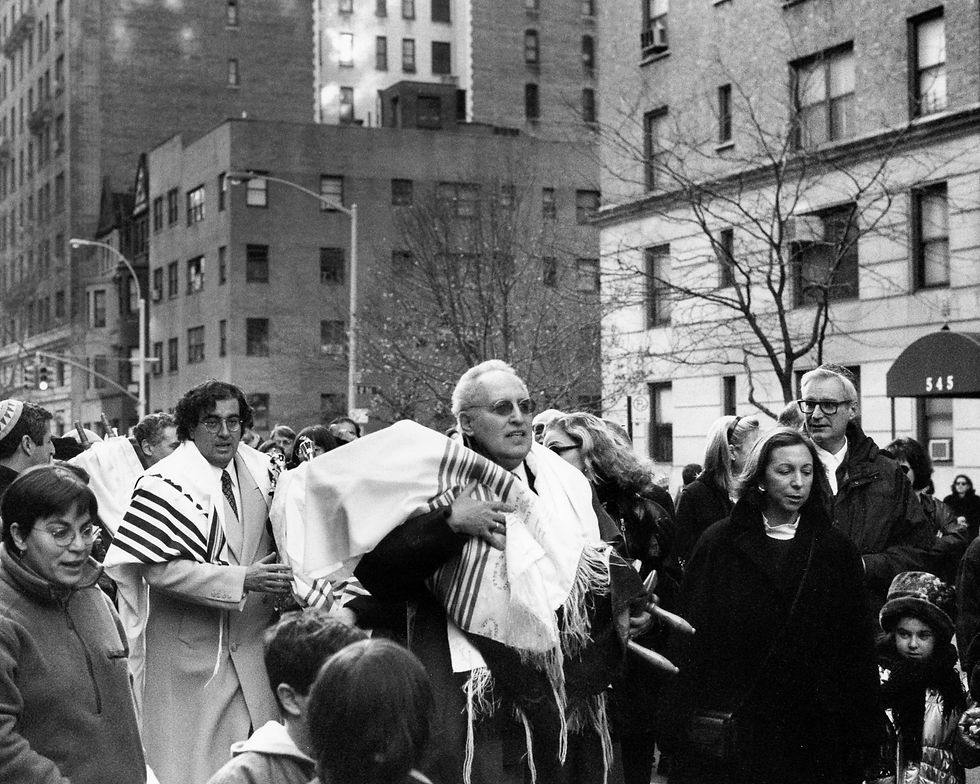
Celebration marking the return to 88th Street from the Church of St. Paul St. Andrew.
Recognizing that many people in the community were building Jewish homes that included multiple heritages, faith backgrounds, and pathways into Judaism, BJ set out to articulate a thoughtful, values-driven framework—one that honored Jewish tradition while responding to the lived experiences of its members. This evolved into the Jewish Home Project and a sustained communal conversation about Jewish identity, belonging, and family life.
This work was grounded in a simple but demanding conviction: that welcoming complexity strengthens Jewish life. Rather than offering narrow definitions of belonging, BJ invested in deep listening, learning, and dialogue, asking how the synagogue could support vibrant Jewish living in homes, relationships, and families as they actually exist today. The result was not a single policy, but a culture—one that affirms commitment, intention, and ongoing Jewish practice as central to communal life.
Today, this approach continues to shape BJ’s understanding of who belongs and how Jewish life is nurtured. Multifaith and multiheritage families are woven into the fabric of the community, supported through learning, ritual, and shared experience. In this work, BJ extends a throughline that runs across its history: a willingness to expand the boundaries of Jewish life so that Jewish homes, like BJ itself, remain places of meaning, connection, and responsibility for generations to come.