
Hope & Resilience
BJ and the Moral Demands of Its Time
Throughout History, We Have Stood for Hope & Justice
Throughout the history of B’nai Jeshurun, the congregation has remained deeply connected to the social, spiritual, and humanitarian needs of its community. From advocacy during moments of crisis to strengthening public dialogue and helping vulnerable families, the organization continues to inspire positive social change through compassion and leadership.

Former BJ Rabbi Stephen S. Wise (1894-1900), president of the American Jewish Congress, fought an uphill battle in the 1930s to inform the American government and people about the evils of Nazism. Rabbi Wise publicly advocated an Olympics boycott and urged Jewish athletes not to participate. Here he addresses a crowd in Battery Park, New York on May 10 in the protest against mistreatment of Jews in Germany. Photo Credit: Bettmann Archive / Getty Images
Prayers of thanks are offered on the first day of the newborn State of Israel at B'nai Jeshurun on May 15, 1948. Left to right are Jacob Sincoff, acting President; Rabbi Israel Goldstein, Cantor Jacob Schwartz and Morris J. Bernstein. Photo Credit: Bettmann Archive / Getty Images

Advocacy During the Holocaust & Support for Jewish Self Determination
Advocacy During the Holocaust & Support for Jewish Self Determination
Prayers of thanks are offered on the first day of the newborn State of Israel at B'nai Jeshurun on May 15, 1948. Left to right are Jacob Sincoff, acting President; Rabbi Israel Goldstein, Cantor Jacob Schwartz and Morris J. Bernstein. Photo Credit: Bettmann Archive / Getty Images
Advocacy During the Holocaust & Support for Jewish Self Determination
Former BJ Rabbi Stephen S. Wise (1894-1900), president of the American Jewish Congress, fought an uphill battle in the 1930s to inform the American government and people about the evils of Nazism. Rabbi Wise publicly advocated an Olympics boycott and urged Jewish athletes not to participate. Here he addresses a crowd in Battery Park, New York on May 10 in the protest against mistreatment of Jews in Germany. Photo Credit: Bettmann Archive / Getty Images
During the 1930s and 1940s, Rabbi Israel Goldstein and B’nai Jeshurun used their voice to call attention to the growing crisis in Europe. Goldstein publicly pressured the U.S. government to accept more refugees fleeing persecution in Nazi Germany and spoke forcefully about reports of mass murder as the Holocaust unfolded. While B’nai Jeshurun did not run its own refugee-rescue operations overseas, its leaders played an important role in galvanizing American Jewish organizations and the broader public to act. Through moral leadership, advocacy, and fundraising, they contributed to the vital relief efforts of larger Jewish agencies. At the same time, Goldstein and the congregation were vocal supporters of Zionism, advocating for the establishment of a Jewish state as a necessary response to Jewish vulnerability and displacement. In the years following World War II, Goldstein emerged as a leading figure in the global Zionist movement, serving as president of the World Zionist Organization and ultimately relocating to Israel.
Dialogue and the Public Square
In 1963, Dr. Martin Luther King Jr. received the Men’s Club’s Seventeenth Annual Brotherhood Day Award at BJ,presented by Rabbi William Berkowitz (rabbi, 1951–1984).

In the mid-twentieth century, BJ became a national center for public Jewish conversation through the Dialogue Forum Series, founded by Rabbi William Berkowitz in 1951. At a time when Jewish learning was often inward-facing, Rabbi Berkowitz brought major public figures into live conversation with a rabbi on a synagogue bimah and, soon, on some of New York’s largest stages. These dialogues were not lectures but probing, respectful interviews that explored politics, ethics, faith, and human responsibility through a Jewish lens.
The series quickly outgrew BJ’s Sanctuary, drawing crowds of 4,000–5,000 people at venues including Town Hall, Lincoln Center, and the Beacon Theatre. Rabbi Berkowitz spoke with hundreds of influential voices—from Elie Wiesel, Abraham Joshua Heschel, Menachem Begin, and Viktor Frankl to artists, writers, religious leaders, and political figures. Among them was Dr. Martin Luther King Jr., who appeared at BJ and was honored by the B’nai Jeshurun Men’s Club, an enduring symbol of BJ’s commitment to moral leadership and interfaith engagement. The Dialogue Forum reflected a core BJ conviction: that Judaism belongs in conversation with the wider world.

Housing Crisis and Food Insecurity
In 1985, as homelessness surged across New York City, B’nai Jeshurun partnered with the Church of St. Paul and St. Andrew to open a shelter. What began as an emergency response to the housing crisis evolved into a year-round women’s shelter, offering stability, warmth, and community for those navigating housing insecurity.
A year later, BJ created the Judith Bernstein Lunch Program. Named for a beloved BJ member tragically killed on Pan Am Flight 103, this initiative evolved from simply handing out brown-bag lunches on the street to serving an average of 110 guests a full, home-cooked, sit-down meal served every week. Volunteers not only cook and serve but build relationships across difference, offering dignity and companionship along with nourishment.
Irma Radus at at the Judith Bernstein Lunch Program.

BJ Community marches in one of the many HIV/AIDS walks in New York City.
Marching to Albany for Marriage Equality, April 2009.
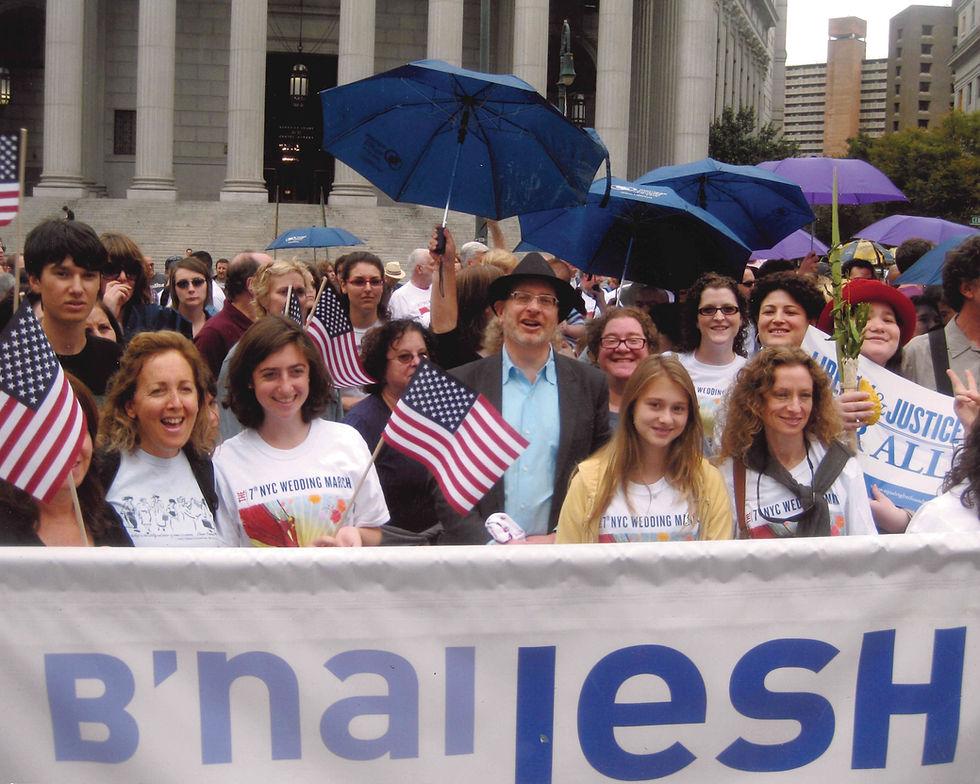

Joe Antenson, Council Member Danny O’Donnell, Dale Bernstein, and Lisa Zucker, with BJ’s commemorative pen from the signing of the marriage equality act in 2011.
Judith Trachtenberg and Renie Rutchick, z"l, were the first lesbian couple to be legally married at BJ after the Marriage Equality Act was passed in New York State.
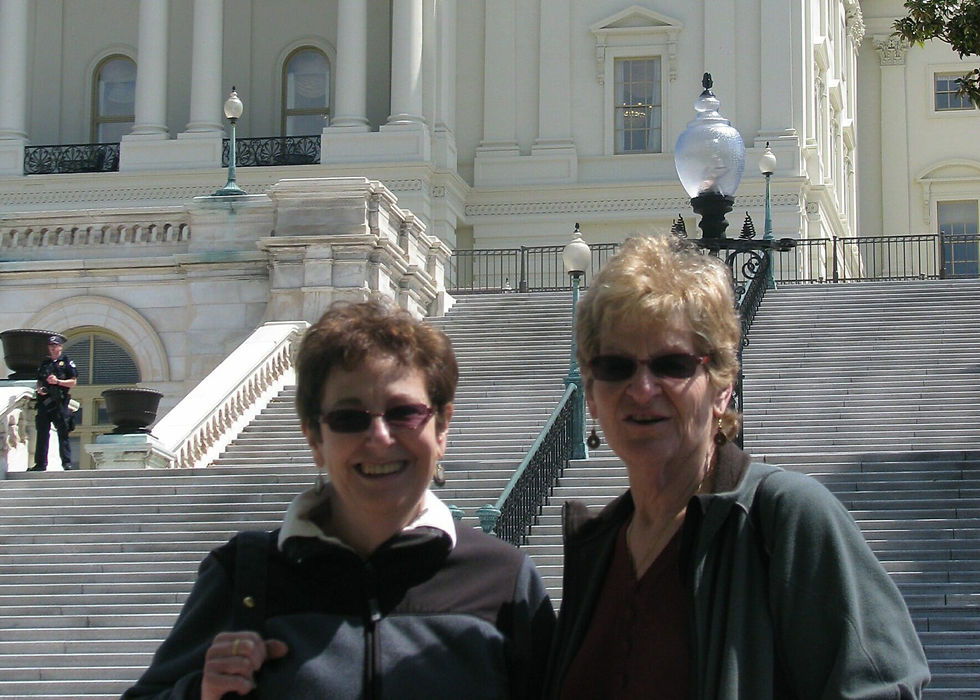
As the HIV/AIDS epidemic ravaged New York City, B’nai Jeshurun became a refuge for those facing illness, grief, and isolation—especially within the LGBTQ+ Jewish community. At a moment when many synagogues were not welcoming to gay and lesbian Jews, BJ opened its doors. The congregation confronted widespread fear and stigma through education, pastoral care, and public witness. Monthly Shabbat speakers—including people living with AIDS, family members, and physicians—helped dispel community anxieties and reshape attitudes. As Rabbi Roly Matalon later recalled, “The stories and the suffering and the fear and the need for people to hold on to Judaism—holding onto faith, trying to find hope—were incredibly moving. It was one of the most moving things we ever did here.”
In 1986, BJ launched Spiritual Gatherings for People with AIDS: Shabbat lunches cooked and served entirely by volunteers, where guests, partners, parents, and caregivers shared meals, prayer, and stories. For many, it was the first time they had felt welcome in a synagogue since coming out. Word spread quickly that BJ was a place where LGBTQ+ Jews were unequivocally embraced by the congregation. This led to the formation of BJ’s first Gay and Lesbian Committee in 1991 and, soon after, the congregation’s first lesbian wedding.
In the years that followed, BJ’s mission evolved—shifting from crisis response to a long-term dedication to dignity and justice through LGBTQ+ advocacy. In the early 2000s, Panim el Panim listening campaigns surfaced the need for LGBTQ+ civil rights within the congregation. A decade later, BJ emerged as a leader in statewide marriage-equality efforts: hosting Civil Rights and Sacred Rites in 2006—an unprecedented interfaith prayer gathering of 500 people and 22 clergy; traveling repeatedly to Albany for Equality & Justice Lobby Days; organizing educational programs; and joining coalition partners across New York. More than 100 BJ members marched across the Brooklyn Bridge in the 2010 “wedding march” for equality. When New York State passed Marriage Equality in 2011, BJ was honored by ESPA and MENY for its leadership—marking a milestone in a decades-long commitment to affirming the dignity, safety, and sacred belonging of LGBTQ+ people at every stage of life.
Responding to the HIV/AIDS Crisis and Advancing LGBTQ+ Rights
Ceiling Collapse
The sanctuary—once a jewel box of Coptic-inspired blues, buffs, reds, and golds—was crowned by an octagonal ceiling carved with intricate segmental arches and dramatic stalactites illuminated by hidden lighting. That soaring, historic beauty came crashing down in May 1991, when half a ton of plaster from the original ceiling suddenly collapsed onto the bimah and surrounding area. Miraculously, the sanctuary was empty and no one was hurt.
The disaster became a turning point. With our spiritual home in crisis, BJ was welcomed almost immediately by the Church of St. Paul and St. Andrew. What began as a practical solution quickly became the foundation of a deep and enduring partnership between two communities of faith. SPSA opened its doors with open hearts, offering BJ a space to gather, pray, and celebrate Shabbat and holidays, not for weeks but for years, and it still continues to this day. The relationship was rooted in mutual respect, shared dreams of justice and spiritual vitality, and an abiding sense of sacred hospitality.
After extensive restoration, the sanctuary was rededicated in 1996 with a new grid-patterned ceiling and programmable lighting system that honors the grandeur of the original design while transforming the space into an open, flexible, multi-use home for the community.
The 88th Street Sanctuary ceiling before and after the May 1991 collapse.


A Sanctuary Amid Turmoil: BJ Responds to 9/11
In the days and months following the attacks on the World Trade Center in 2001, B’nai Jeshurun became a place of refuge for a city in shock. The Sanctuary remained open for those seeking comfort, solace, and community. BJ’s spiritual leaders offered pastoral support to first responders, families of the missing, and New Yorkers struggling to make sense of the devastation.
BJ members mobilized quickly. By September 25, just two weeks after the attacks, 150 community members were volunteering at Ground Zero; in total, more than 800 BJ volunteers contributed their time and energy in the weeks that followed. Community members provided care in ways both practical and spiritual—cooking meals, distributing essentials, offering comfort, and bearing witness to grief and courage alike.
Myriam Abramowicz recalls, “During the night we were escorted to Ground Zero. I had been to Hiroshima and Nagasaki and more recently to Kosovo where there were kilometers and kilometers of devastation, but somehow this contained area of destruction looked like nothing I had witnessed over there. This was Babi Yar. A mass burial ground. Roly called it makom kadosh, a holy place. I knew I was looking squarely in the eyes of a nightmare, and that when I would wake from it only the dust gathered on my shoes would be proof that it was, unfortunately, not a dream.”
Read additional reflections written at the time by BJ members who volunteered on the laminated sheet in this file jacket.
A Sanctuary Amid Turmoil: BJ Responds to 9/11
In the days and months following the attacks on the World Trade Center in 2001, B’nai Jeshurun became a place of refuge for a city in shock. The Sanctuary remained open for those seeking comfort, solace, and community. BJ’s spiritual leaders offered pastoral support to first responders, families of the missing, and New Yorkers struggling to make sense of the devastation.
BJ members mobilized quickly. By September 25, just two weeks after the attacks, 150 community members were volunteering at Ground Zero; in total, more than 800 BJ volunteers contributed their time and energy in the weeks that followed. Community members provided care in ways both practical and spiritual—cooking meals, distributing essentials, offering comfort, and bearing witness to grief and courage alike.
Myriam Abramowicz recalls, “During the night we were escorted to Ground Zero. I had been to Hiroshima and Nagasaki and more recently to Kosovo where there were kilometers and kilometers of devastation, but somehow this contained area of destruction looked like nothing I had witnessed over there. This was Babi Yar. A mass burial ground. Roly called it makom kadosh, a holy place. I knew I was looking squarely in the eyes of a nightmare, and that when I would wake from it only the dust gathered on my shoes would be proof that it was, unfortunately, not a dream.”
Read additional reflections written at the time by BJ members who volunteered on the laminated sheet in this file jacket.
Cultivating Community in a Time of Social Distance
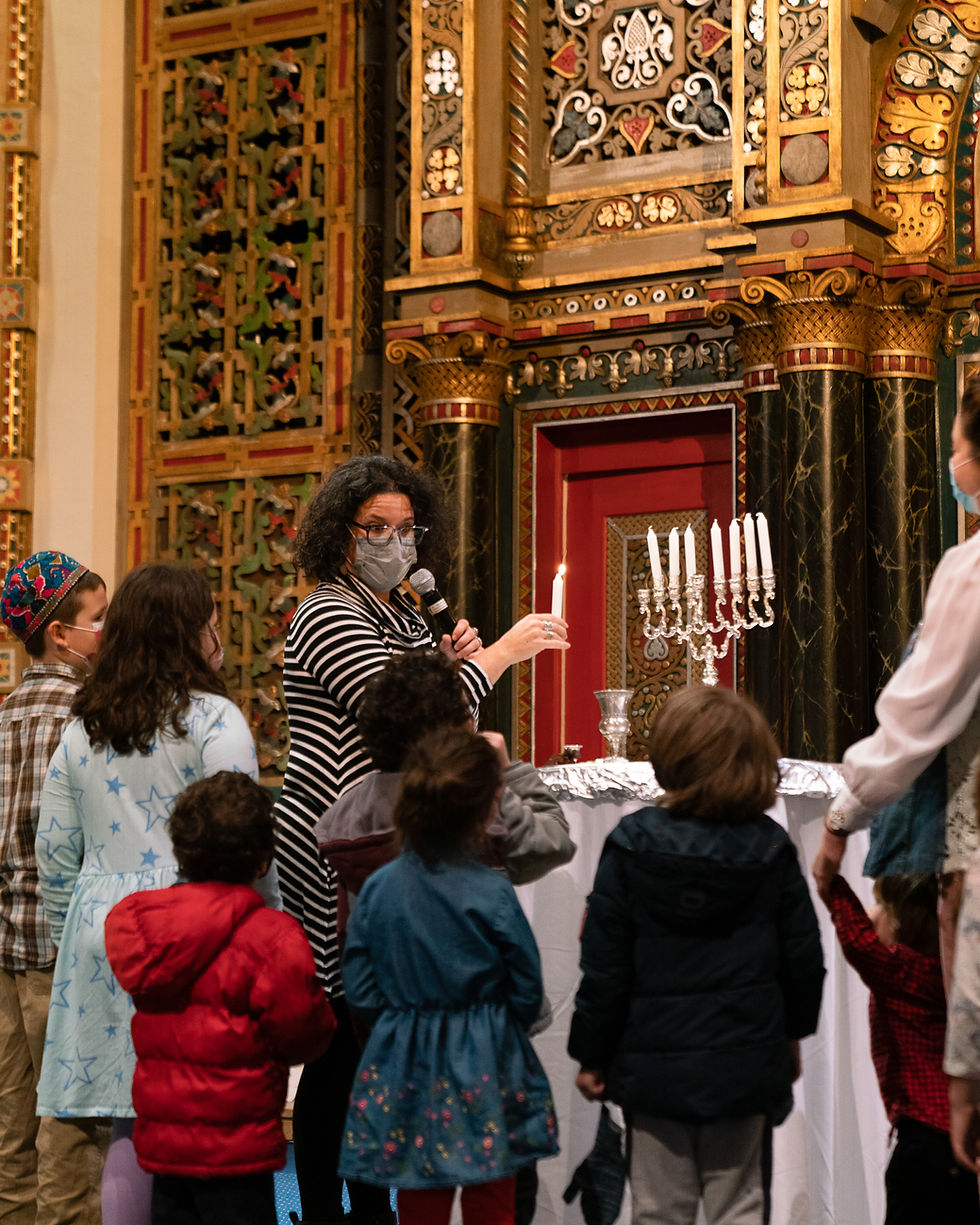
Rabbi Felicia Sol lights Hanukkah candles during a community celebration in 2021.

Cultivating Community in a Time of Social Distance
During the COVID-19 pandemic, the BJ community gathered regularly on Zoom for prayer, learning, and connection—and continues to do so today.
Cultivating Community in a Time of Social Distance
Rabbi Felicia Sol lights Hanukkah candles during a community celebration in 2021.
During the COVID-19 pandemic, the BJ community gathered regularly on Zoom for prayer, learning, and connection—and continues to do so today.

Rabbi William Berkowitz presents Dr. Ralph Bunche of the U.N. Secretariat the Brotherhood Award Scroll on February 21, 1959. Photo Credit: Bettmann Archive / Getty Images
When COVID-19 brought the world to a standstill, B’nai Jeshurun rapidly reimagined every aspect of communal life. Services, learning, and pastoral care moved online within days, ensuring that the community could continue to pray, grieve, and celebrate together despite physical separation. BJ spiritual leaders and volunteers launched extensive outreach, checking in on elders and isolated members, delivering food and supplies, and helping families navigate illness, loss, and financial hardship.
“For people sitting alone with just immediate members of their household unit, we want to give them a sense that we’re in this together, that we’re united in the music, that we’re all united by the moment, by the prayer, and by the spirit,” said Rabbi Roly Matalon. “The greatness of the human spirit is that it can transcend space and time.”
Investing in Your Future
Rooted in the mitzvah of Ahavat Hager (loving the stranger) B’nai Jeshurun mobilized swiftly in response to the refugee and migrant crisis. In 2016, BJ helped launch the Synagogue Coalition on the Refugee & Immigration Crisis (SCRIC), now a network of more than 30 synagogues and nonprofit partners. As active members, BJ supports SCRIC’s advocacy, education, and direct service efforts on behalf of immigrants, refugees, and asylum seekers. Soon after, the Board of Trustees unanimously voted to declare BJ a sanctuary congregation. When asylum seekers began arriving in New York in growing numbers, BJ volunteers expanded their support—accompanying individuals to court hearings, providing transportation and translation, collecting essential supplies, and helping families navigate housing, schooling, and medical care. BJ partnered with HIAS and citywide coalitions, hosting Refugee Shabbat gatherings, community teach-ins, and large-scale advocacy efforts. Co-sponsored by Rutgers Presbyterian Church, members of B’nai Jeshurun launched the Refugee Employment Partnership (REP) in 2017, supporting newly arrived refugees and asylees in securing employment as they start new lives in the New York area.
Every week, BJ hosts respite dinners creating a warm, welcoming, and supportive space for newly arrived asylum seekers living in local migrant shelters. A cornerstone of this initiative is our group cooking program, which invites asylum seekers to prepare and share their traditional cuisines in our kitchen.

Investing in Your Future
Rooted in the mitzvah of Ahavat Hager (loving the stranger) B’nai Jeshurun mobilized swiftly in response to the refugee and migrant crisis. In 2016, BJ helped launch the Synagogue Coalition on the Refugee & Immigration Crisis (SCRIC), now a network of more than 30 synagogues and nonprofit partners. As active members, BJ supports SCRIC’s advocacy, education, and direct service efforts on behalf of immigrants, refugees, and asylum seekers. Soon after, the Board of Trustees unanimously voted to declare BJ a sanctuary congregation. When asylum seekers began arriving in New York in growing numbers, BJ volunteers expanded their support—accompanying individuals to court hearings, providing transportation and translation, collecting essential supplies, and helping families navigate housing, schooling, and medical care. BJ partnered with HIAS and citywide coalitions, hosting Refugee Shabbat gatherings, community teach-ins, and large-scale advocacy efforts. Co-sponsored by Rutgers Presbyterian Church, members of B’nai Jeshurun launched the Refugee Employment Partnership (REP) in 2017, supporting newly arrived refugees and asylees in securing employment as they start new lives in the New York area.
Every week, BJ hosts respite dinners creating a warm, welcoming, and supportive space for newly arrived asylum seekers living in local migrant shelters. A cornerstone of this initiative is our group cooking program, which invites asylum seekers to prepare and share their traditional cuisines in our kitchen.
Israel, Responsibility, and Shared Jewish Life
BJ’s relationship over the last several decades with Israel is grounded in our deepest commitments as Jews: responsibility for one another, a sacred connection to our ancestral homeland, and an obligation to uphold the dignity of every human being.
Israel is central to Jewish life—spiritually, culturally, and politically—and its future matters profoundly. For decades, BJ has lived this relationship through learning, dialogue, advocacy, and ongoing partnerships and travel, bringing BJ members to Israel and welcoming Israeli rabbis, educators, and community leaders into the life of the congregation. These relationships—spanning institutions such as HaMidrasha at Oranim, Beit Tefilah Israeli, Kol HaNeshama, the Jerusalem campus of Hebrew Union College-Jewish Institute of Religion and others—have shaped BJ’s understanding of Israel as a living, pluralistic Jewish society, and deepened a shared commitment to Israel’s safety, democracy, and moral character, alongside recognition that the Palestinian people are also entitled to dignity, safety, and self-determination.
The events of October 7 marked a profound rupture for Israel and for Jewish communities worldwide. In response, BJ has sought neither silence nor simplicity, but sustained presence: advocating for the release of hostages, creating space for grief and prayer, and engaging openly with the moral and spiritual questions facing Jews in this moment. Longstanding partnerships took on renewed urgency, as Israeli colleagues joined BJ to reflect together on loss, resilience, and the future of Jewish life. Guided by values of human dignity, responsibility, pluralism, and the pursuit of justice and peace, BJ continues to nurture a relationship with Israel rooted in love, honesty, and courage while holding complexity.
Hostages and Missing Family Forum posters for those taken on October 7 were posted in the Sanctuary balcony and Delegation of Israeli partners from across a pluralistic Jewish landscape, welcomed to BJ in May 2025.

